The Best Investment you'll ever Make is in Yourself


When life gets busy, sleep is often the first thing people trade for more time. The problem is that repeated short nights can make focus, energy, mood, and everyday decision-making feel harder, which may actually make a demanding schedule less manageable. A consistent wind-down routine, realistic boundaries, and the right kind of nutritional support can help you build a healthier relationship with rest without expecting any supplement to replace sleep itself.
Why Sleep Keeps Losing the Negotiation
“I’ll go to bed after I answer these emails.”
“I just need to finish one more thing.”
“I can sleep in this weekend.”
For many people, these thoughts feel completely reasonable in the moment. Sleep can seem flexible because the consequences of staying up another hour are not always immediate. There is no alarm that goes off the instant your body has had enough, and the extra time can feel useful when work, family responsibilities, housework, or unfinished tasks are competing for attention.
That is why sleep often becomes the easiest thing to postpone.
The trouble is that rest is not simply empty time between productive hours. Sleep is part of the daily rhythm that supports how you feel and function the next day, including your ability to pay attention, make decisions, respond to stress, and maintain normal physical recovery. When sleep is repeatedly shortened, people may begin compensating with more caffeine, longer work hours, extra screen time, or weekend sleeping, which can make the routine even less consistent.
This is also why conversations around sleep support, stress management, magnesium glycinate, relaxation, energy, and evening routines often overlap. People are not always looking for a “sleep product.” More often, they are looking for a way to move from a busy, mentally active day into an evening that actually feels different.
The first step is not finding the perfect supplement. It is recognizing that waiting for life to become less busy may mean waiting indefinitely.
The Problem With “Catching Up Later”
It is tempting to think of sleep like a bank account. Lose a couple of hours Monday through Friday, then deposit them back with a long Saturday morning.
Real life is more complicated.
One well-known controlled study looked at the effects of repeated sleep restriction on cognitive performance. Van Dongen and colleagues found that when participants were limited to shorter sleep opportunities over multiple days, deficits in attention and performance accumulated over time, even though people did not always accurately perceive how impaired they had become.
That is an important distinction. You may feel as though you are “getting used to” six hours of sleep, but feeling accustomed to a routine is not necessarily the same as functioning at your best.
This does not mean one late night permanently damages your health, nor does it mean sleeping longer after a difficult week is useless. It simply means that regularly postponing sleep and assuming one long weekend morning will erase the effects is not a particularly reliable long-term strategy.
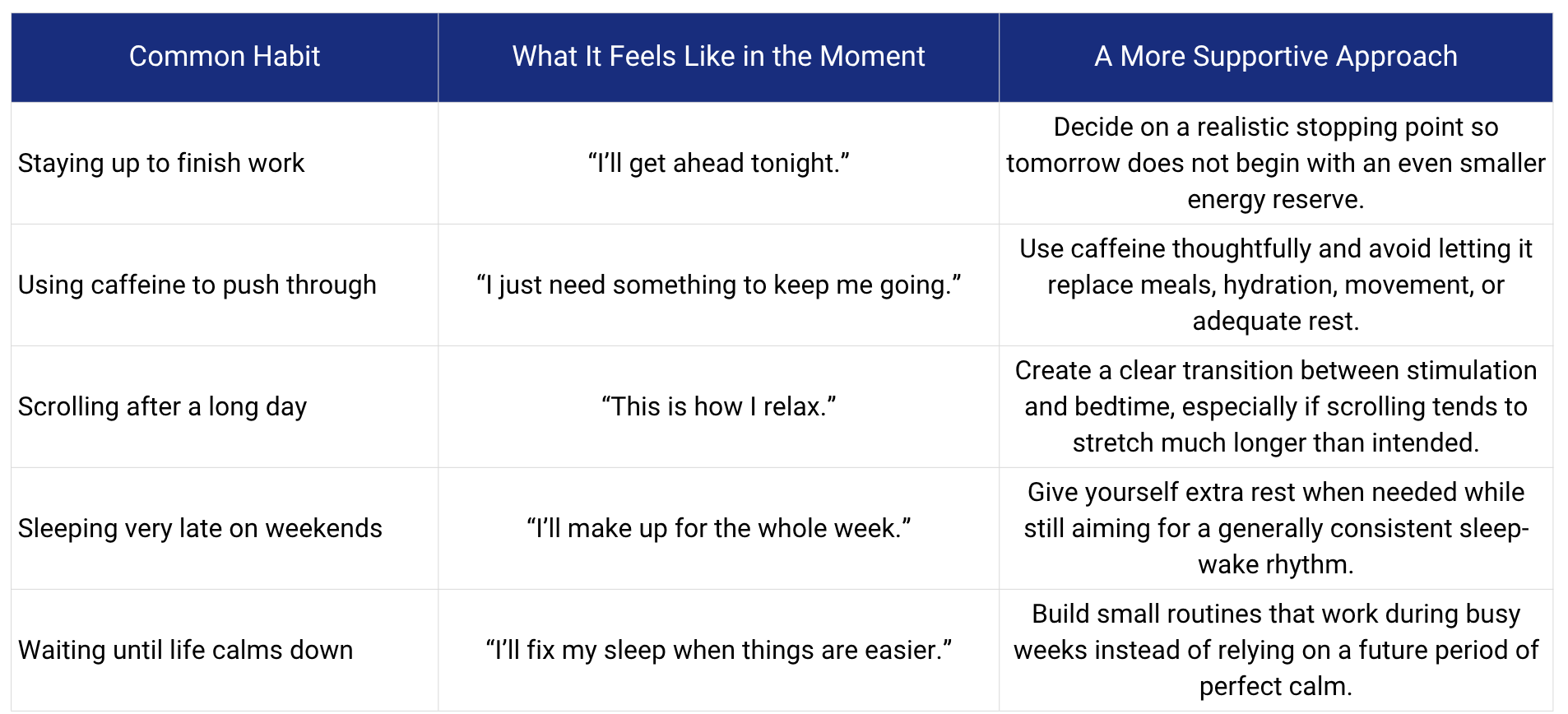
What Repeated Short Nights Can Do to Your Day
The effects of poor sleep do not always show up as dramatically falling asleep at your desk. Sometimes they are much quieter.
You may reread the same email three times. A normal task may feel unusually frustrating. You may reach for another coffee because your afternoon feels heavier than expected, or you may have less patience for decisions that would normally feel simple.
This is one reason “more waking hours” does not automatically equal more productive hours.
When you are stretched thin, the issue is not simply physical tiredness. Mental performance, emotional regulation, motivation, and the ability to shift attention can all feel different after inadequate rest. Van Dongen et al. (2003) demonstrated that repeated partial sleep restriction can produce cumulative performance deficits, which helps explain why several mildly shortened nights may matter more than we sometimes assume.
That does not mean every tired afternoon is caused by sleep. Fatigue can have many causes, including lifestyle factors, nutrient status, medications, health conditions, stress, and other issues. Persistent or unexplained fatigue deserves a conversation with a healthcare professional rather than being automatically blamed on a busy schedule.
Still, if your pattern is consistently “work later, sleep less, push harder tomorrow,” sleep is a very reasonable place to start looking.
A Better Way to Wind Down
A supportive evening routine does not need to look like a two-hour wellness ceremony with candles, herbal tea, journaling, stretching, meditation, and a perfectly organized bedroom. For most people, that is not realistic.
A better routine is one you can repeat.
Start with a stopping cue. This could be an alarm on your phone that tells you the workday is finished, a set time when the laptop closes, or a simple rule that emails are no longer answered after a certain hour. The goal is to stop relying on the feeling of being “done,” because there will almost always be another task waiting.
Next, reduce the contrast between your day and your bedtime. Going directly from a fast-paced work session to lying in the dark can feel abrupt. A brief transition—showering, reading, preparing clothes for the morning, stretching lightly, or spending a few minutes away from screens—can create a clearer boundary between activity and rest.
You can also look at your physical routine. Hydration, regular meals, movement, and adequate nutrient intake matter to everyday energy and wellbeing. Magnesium is one nutrient involved in normal muscle function and normal nervous system function, which is why magnesium supplements are often included in evening wellness routines.†
The key is not turning the routine into another performance goal. It is creating fewer reasons to bargain with yourself at bedtime.
Choosing Support Based on What You Need
If you want nutritional support alongside your daily routine, it can help to start with the question: What am I actually trying to support?
If your main concern is how you handle a demanding day, 1 Body Adrenal Support may be the more natural fit. The formula is designed around everyday stress-response wellness, calm energy, and focus, making it an option for people who want nutritional support during periods when their schedule feels consistently demanding.† It should not be viewed as a treatment for “adrenal fatigue,” insomnia, anxiety, or elevated cortisol.
If your preference is more physical and evening-oriented, 1 Body Magnesium Glycinate Complex may make more sense. Magnesium supports normal muscle function and contributes to normal nervous system function, while the formula is positioned around calmness and relaxation as part of an evening wellness routine.†
They are not two products that everyone needs to stack together. Think of them more like two different paths: Adrenal Support if your priority is daytime stress-response and steady-function support, or Magnesium Glycinate Complex if your priority is evening calm, muscle relaxation, and magnesium intake.
That distinction keeps the choice simple and lets the product fit your routine rather than forcing your routine to fit the product.
Frequently Asked Questions
-
Sleeping longer after a short week may help you feel more rested, but it does not necessarily erase all of the effects of repeated sleep restriction. A generally consistent sleep routine is usually a more sustainable approach than repeatedly alternating between short nights and very long recovery mornings.
Rest Works Better When It Is Part of the Plan
The problem with saying “I’ll sleep when I’m less busy” is that life does not usually send a formal announcement that the busy season has ended. There is always another deadline, another email, another chore, or another reason to stay awake for thirty more minutes.
A more realistic approach is to stop treating rest as something you earn after everything else is finished. Sleep can be part of the structure that helps you handle everything else more effectively.
Start small. Choose a reasonable stopping time, create a short wind-down routine, pay attention to the habits that keep you stimulated late at night, and give yourself permission to protect rest even when your to-do list is not empty.
If you want nutritional support as part of that routine, choose according to what matters most to you rather than assuming more products are automatically better.
Two Different Ways to Support Your Routine
1 Body Adrenal Support and 1 Body Magnesium Glycinate Complex are designed for different wellness priorities. Adrenal Support is better suited to someone looking for daytime stress-response, calm-energy, and focus support, while Magnesium Glycinate Complex offers a magnesium-centered option for normal muscle function, calmness, and evening relaxation.†
-
Adrenal Support: Supports everyday stress-response wellness†
-
Adrenal Support: Formulated to support calm energy and focus†
-
Magnesium Glycinate Complex: Supports normal muscle function†
-
Magnesium Glycinate Complex: Supports calmness and relaxation†
-
Magnesium Glycinate Complex: Provides magnesium to support normal nervous system function†
-
Choose based on your routine: Daytime stress-response support or evening magnesium and relaxation support
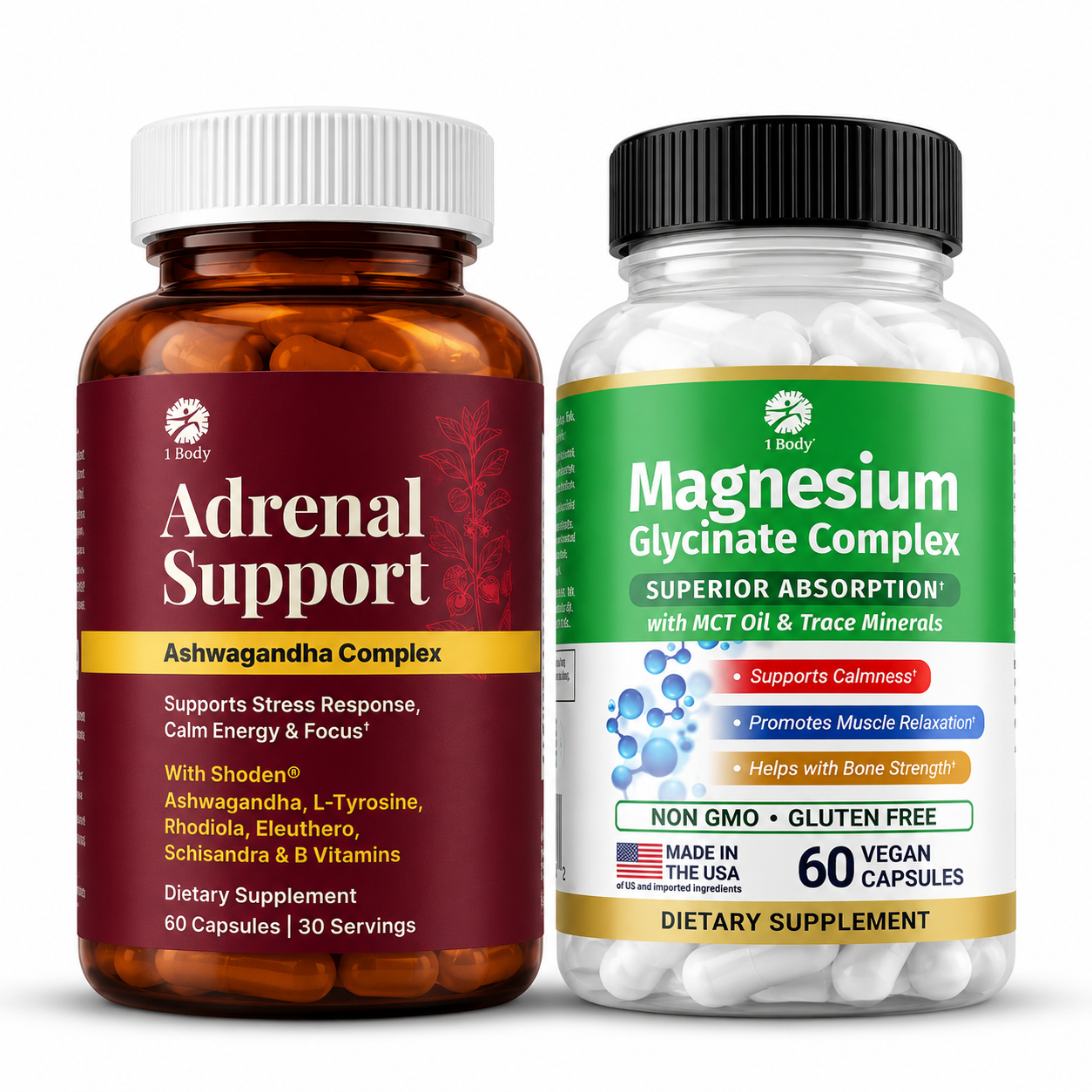
If your days feel demanding and you want a formula geared toward maintaining steady, everyday stress-response support, consider 1 Body Adrenal Support. If you prefer a simpler magnesium-focused option for your evening routine and normal muscle relaxation, 1 Body Magnesium Glycinate Complex may be the better match.
†These statements have not been evaluated by the Food and Drug Administration. These products are not intended to diagnose, treat, cure, or prevent any disease.
Reference
Van Dongen, H. P. A., Maislin, G., Mullington, J. M., & Dinges, D. F. (2003). The cumulative cost of additional wakefulness: Dose-response effects on neurobehavioral functions and sleep physiology from chronic sleep restriction and total sleep deprivation. Sleep, 26(2), 117–126. https://doi.org/10.1093/sleep/26.2.117
For all general inquiries, please contact us at help@1body.com
© Copyright. All rights reserved.