The Best Investment you'll ever Make is in Yourself


Morning sunlight plays a key role in regulating your body’s internal clock by triggering the Cortisol Awakening Response and helping set the timing for melatonin later in the day. When this rhythm is disrupted, it may contribute to grogginess, brain fog, and irregular sleep patterns. A simple habit of getting 10–20 minutes of early light exposure can help reinforce this cycle. Alongside lifestyle habits, supporting cortisol balance and circadian rhythm through consistent routines may help promote more stable energy and focus throughout the day.
The Biology of Morning Light and Your Internal Clock
Your body operates on a built-in timing system known as the circadian rhythm, a roughly 24-hour cycle that regulates sleep, energy, hormones, and even mood. At the center of this system is a small region in the brain called the suprachiasmatic nucleus (SCN).
When sunlight enters your eyes in the morning, it activates specialized light-sensitive cells. These cells send a direct signal to the SCN, essentially telling your brain that a new day has begun. This signal influences multiple processes at once, including alertness, body temperature, and hormone release.
What makes this system unique is that it relies heavily on timing and consistency. Morning light carries a different biological message than midday or evening light. It acts as a “reset point,” helping align your internal rhythm with the external environment.
The Cortisol Awakening Response Explained
One of the first responses triggered by morning light is known as the Cortisol Awakening Response (CAR). Within the first 30 to 45 minutes after waking, cortisol levels naturally rise.
Although cortisol is often associated with stress, it also plays a role in alertness and energy mobilization. This early rise helps transition your body from a resting state into an active one.
When this response aligns with natural light exposure, it tends to follow a more predictable pattern. However, when mornings are spent in low light or artificial environments, this signal may become less defined.
This doesn’t mean the system stops working, but it may feel less synchronized, which can influence how your energy unfolds throughout the day.
The Cortisol-Melatonin Connection
Cortisol and melatonin are often described as opposite ends of the same cycle. One supports wakefulness, while the other is associated with sleep.
Morning light helps initiate cortisol activity, but it also indirectly sets the stage for melatonin production later in the evening. This creates a kind of internal countdown.
Roughly 12 to 14 hours after morning light exposure, the body begins shifting toward melatonin release. If that initial signal is weak or inconsistent, the timing of this transition may also feel off.
This is why some people experience the “wired but tired” feeling, alert at night but sluggish during the day. It’s often less about one hormone and more about the coordination between both.
Why Modern Life Disrupts This Natural Rhythm
Despite how naturally this system is designed, modern routines often work against it.
Many people wake up and remain indoors for extended periods, exposed only to artificial lighting. Compared to natural sunlight, indoor light is significantly weaker in intensity and lacks the same spectrum.
At the same time, evening exposure to screens and artificial light introduces stimulation at a time when the body expects darkness.
Other contributing factors include:
-
Irregular sleep schedules
-
Limited outdoor exposure
-
Early or late work hours
-
Seasonal daylight changes
These patterns don’t stop the circadian system from functioning, but they can make it feel less stable.
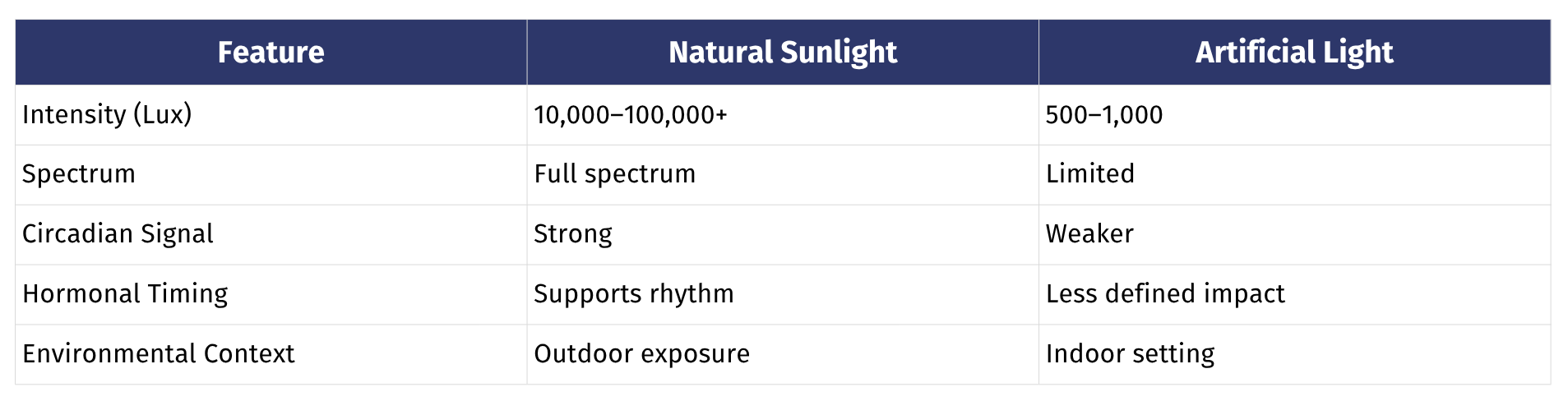
This difference helps explain why stepping outside, even briefly, often feels more energizing than staying under indoor lighting.
The “Wired but Tired” Effect
When circadian timing becomes inconsistent, it can show up in subtle ways.
Some people notice difficulty feeling fully alert in the morning, followed by a surge of energy later in the evening. Others may experience dips in focus during the day or feel mentally “on” but physically fatigued.
This pattern is often described as being “wired but tired.” It reflects a mismatch between the body’s internal signals and external cues.
Rather than pointing to a single cause, it often represents a combination of factors, including light exposure, stress levels, and daily habits.
Building a Consistent Morning Light Ritual
Establishing a morning light routine does not need to feel overwhelming or rigid. In fact, the goal is not perfection—it’s consistency that fits into your real life. Small, repeatable actions tend to be more effective over time than occasional, ideal scenarios that are difficult to maintain.
Start within the first hour of waking
Try to step outside as part of something you already do, like drinking your coffee, checking your phone, or taking a short walk. Anchoring light exposure to an existing habit makes it easier to repeat without relying on motivation.
Keep it simple and realistic
Even a few minutes outdoors can provide a stronger light signal than staying indoors. On busier days, a brief exposure is still valuable. This helps remove the “all-or-nothing” mindset that often breaks routines.
Focus on consistency over duration
It’s more beneficial to get light exposure every day for a short time than to do longer sessions inconsistently. Your circadian rhythm responds best to regular signals, not occasional extremes.
Pair it with movement or routine triggers
Linking sunlight exposure with daily actions—like walking your dog, commuting, or stretching—turns it into an automatic behavior rather than a separate task you have to remember.
Adapt instead of skipping
Weather, schedules, and seasons will change. Instead of skipping the habit, adjust it. On cloudy days, spend a little more time outside. On busy mornings, step out briefly rather than not at all. Flexibility is what makes a routine sustainable.
Reduce friction wherever possible
Lay out clothes the night before, keep shoes by the door, or choose a consistent outdoor spot. The fewer decisions you have to make in the moment, the easier it becomes to follow through.
Over time, these small actions begin to stack. What starts as a conscious effort gradually becomes part of your normal rhythm. This is where consistency turns into automatic behavior, helping reinforce your body’s natural timing without requiring constant effort or discipline.
The Role of Stress and Cortisol Balance
While light exposure helps initiate daily rhythms, stress levels can also influence how those rhythms feel.
Cortisol naturally fluctuates throughout the day, but chronic stress may affect how smoothly these changes occur. When stress levels remain elevated, the distinction between “wake” and “rest” signals may feel less clear.
This is where the concept of cortisol balance becomes relevant. Supporting the body’s stress response through lifestyle habits—such as sleep consistency, nutrition, and relaxation practices—can help reinforce overall rhythm.
Keywords such as cortisol support, stress balance, and adaptogens are often associated with routines designed to support this process.
Supporting Research
Research has explored how light exposure influences circadian rhythms and hormonal patterns, particularly in relation to sleep-wake cycles and daily physiological timing.
A study published in Endocrine Connections examined how environmental light interacts with the circadian system, including its influence on hormonal regulation such as cortisol rhythms. The findings highlight that light exposure plays a central role in synchronizing the body’s internal clock, helping align biological processes with the external day-night cycle.
The study also observed that exposure to bright light in the morning was associated with measurable changes in cortisol levels shortly after waking, reinforcing the idea that light acts as a timing signal for daily hormonal patterns. These findings contribute to a broader understanding of how consistent light exposure may influence circadian alignment without suggesting a direct or guaranteed outcome.
Citation: Leproult R, Colecchia EF, L’Hermite-Balériaux M, Van Cauter E. Transition from dim to bright light in the morning induces an immediate elevation of cortisol levels. Endocr Connect. 2017. https://pmc.ncbi.nlm.nih.gov/articles/PMC5424773/pdf/ec-6-100.pdf
Frequently Asked Questions
-
This can vary. On clear days, shorter exposure may be enough, while cloudy conditions may require more time.
Supporting Your Daily Rhythm: Where Cortisol Balance Fits In
For those looking to support cortisol balance, stress response, and daily rhythm, products like 1 Body Cortisol Balance are often included as part of a structured wellness routine alongside habits like morning light exposure.
Formulations that include adaptogens such as ashwagandha and rhodiola are commonly discussed in relation to how the body responds to daily stressors, especially when routines feel inconsistent. When paired with foundational habits like consistent sleep and early light exposure, this type of support can help reinforce a more stable daily pattern rather than relying on short-term energy boosts.
Conclusion: Aligning With Your Natural Rhythm
Your body already has a built-in system designed to regulate energy, alertness, and rest. Morning sunlight acts as one of the most important signals that helps keep this system aligned.
In modern environments, where natural light exposure is often limited, small adjustments can help restore a sense of rhythm. Stepping outside in the morning, maintaining consistent routines, and supporting stress balance all contribute to a more stable daily pattern.
Rather than relying on a single solution, combining these elements creates a more sustainable approach to energy and recovery.
Featured Product: 1 Body Cortisol Balance
If you’re building a routine around cortisol balance and daily rhythm support, this formula is designed to complement that process.
Key features include:
-
Includes adaptogens such as Ashwagandha and Rhodiola
-
Supports stress response as part of a daily routine
-
Designed to complement circadian rhythm habits
-
Helps support consistent energy patterns
-
Easy-to-use format for long-term consistency
By combining structured habits with targeted support, you can create a routine that aligns more closely with your body’s natural timing.

For all general inquiries, please contact us at help@1body.com
© Copyright. All rights reserved.