The Best Investment you'll ever Make is in Yourself


Staying active does not have to mean forcing yourself through workouts you dislike. Walking, dancing, gardening, household activity, outdoor adventures, and other forms of joyful movement can all contribute to a more active lifestyle, while good nutrition, hydration, rest, and thoughtful nutritional support can help you build a routine that feels realistic enough to keep.
When a new season arrives, motivation can change right along with the weather. Cooler mornings may make an outdoor walk more appealing, shorter afternoons can make an after-work gym session feel less inviting, and fuller schedules can turn a carefully planned fitness routine into yet another obligation competing for your attention.
That is why redefining what it means to “stay active” can be so refreshing. Physical activity does not have to happen exclusively in a gym, require a perfectly coordinated workout set, or leave you exhausted to matter. Everyday movement, joyful movement, active hobbies, walking, gardening, dancing, and even the small movements that happen throughout a normal day can all contribute to an active lifestyle.
The real challenge for many people is not finding the hardest workout. It is finding movement they can imagine doing again tomorrow, next week, and after the initial burst of motivation has faded. When movement fits naturally into your interests and daily routine, consistency can start to feel less like discipline and more like part of how you live.
Why Movement Does Not Have to Look Like a Workout
For years, exercise has often been presented as something highly structured: a specific number of minutes on a treadmill, a certain number of repetitions, or a workout that needs to be completed before it “counts.” Structured exercise can certainly have a place in a healthy lifestyle, but it is only one form of physical activity.
Movement can also be the twenty-minute walk you take while catching up with a friend, the music you put on while cleaning the kitchen, the afternoon spent tending a garden, or the decision to walk around the block instead of immediately sitting down after dinner. These activities may feel less formal, yet they still get the body moving and can make a sedentary day more active.
This more flexible approach is sometimes called joyful movement because the emphasis shifts away from punishment, calorie burning, or earning food and toward choosing physical activity that feels satisfying, energizing, social, relaxing, or simply enjoyable.
The word “joyful” does not mean every minute has to feel effortless. A hill may still make your legs work, and carrying gardening supplies may still leave you breathing harder than when you started. The difference is that the activity has a reason beyond completing a workout simply because you feel you should.
Perhaps you love wandering through a local park with no concern about pace. Maybe you would rather dance in your living room than spend half an hour on a stationary bike. You may discover that a Saturday morning spent working in the yard gives you more natural movement than a gym session you repeatedly postpone.
When you stop trying to force yourself into someone else’s definition of exercise, you have more room to find activities that suit your body, schedule, interests, and current season of life.
The Everyday Movement You May Already Be Doing
Not all physical activity happens during planned exercise. Researchers and health professionals sometimes use the term non-exercise activity thermogenesis, or NEAT, when discussing energy expended through ordinary activities outside intentional exercise, sleeping, and eating.
In practical terms, that includes the movement woven into a normal day: walking through the grocery store, standing while preparing dinner, tidying the house, taking the stairs, carrying laundry, gardening, walking to another office, playing with children, or taking the dog outside.
Recognizing these activities can change how you think about being active. If you sit at a desk for much of the day, you may not need to transform yourself overnight into someone who trains for an hour every morning. You might begin by standing and moving around more frequently, taking a short walk after lunch, doing household chores with a little more intention, or adding an enjoyable outdoor activity to the weekend.
These choices should not become another reason to obsessively track every movement. Their value lies in helping you notice that an active lifestyle can be built from many small opportunities rather than one perfect workout.
You can also use everyday activity to break up long stretches of sitting. Instead of sending a message to someone in the next room, walk over when appropriate. Take a five-minute movement break between long work tasks, walk around while taking a phone call, or spend a few minutes stretching after you close your laptop.
Individually, these moments may feel small. Together, they help create a day with more movement built into it.
Finding Activities You Actually Want to Repeat
The question “What is the best exercise?” is less useful than asking, “What kind of movement can I realistically continue?”
For one person, that might be hiking. Someone else may love swimming, dancing, cycling, pickleball, yoga, gardening, or walking while listening to an audiobook. Another person may prefer ten minutes of movement several times throughout the day rather than one longer session.
Enjoyment matters because an activity has limited practical value if you avoid doing it. You do not have to love every second of physical effort, but there should be something about the experience that makes returning to it worthwhile.
Try connecting movement to something you already enjoy. If you look forward to podcasts, reserve your favorite series for walks. If social connection motivates you, schedule a regular walking date instead of meeting only for coffee. If nature helps you decompress after work, explore different parks rather than repeating the same indoor cardio session.
You can also let your energy level influence the intensity. On a high-energy day, a longer trail walk may sound appealing. After a demanding week, gentle stretching and an easy neighborhood stroll may be more appropriate.
Movement does not have to be all or nothing. Choosing a gentler activity is still choosing to move.
Make Movement Fit the Season You Are In
Seasonal changes create an opportunity to refresh your routine instead of abandoning it. As temperatures cool, outdoor activities that felt uncomfortable during summer may become more enjoyable, including walking, hiking, gardening, cycling, or exploring community events on foot.
At the same time, earlier sunsets can make an evening routine more difficult. If daylight affects your motivation, consider moving your activity earlier instead of assuming you have lost your drive. A lunchtime walk, morning stretch, or short afternoon movement break may suit the season better than insisting on a schedule that worked several months ago.
Indoor options can also keep things flexible on days when the weather does not cooperate. Dancing, mobility exercises, walking through a shopping center, active housework, recreational sports, or a short bodyweight routine can provide alternatives without requiring a full gym setup.
The goal is adaptation rather than perfection. Your summer routine does not have to become your fall routine, and your fall routine does not have to remain unchanged through winter.
Everyday Movement Ideas at a Glance
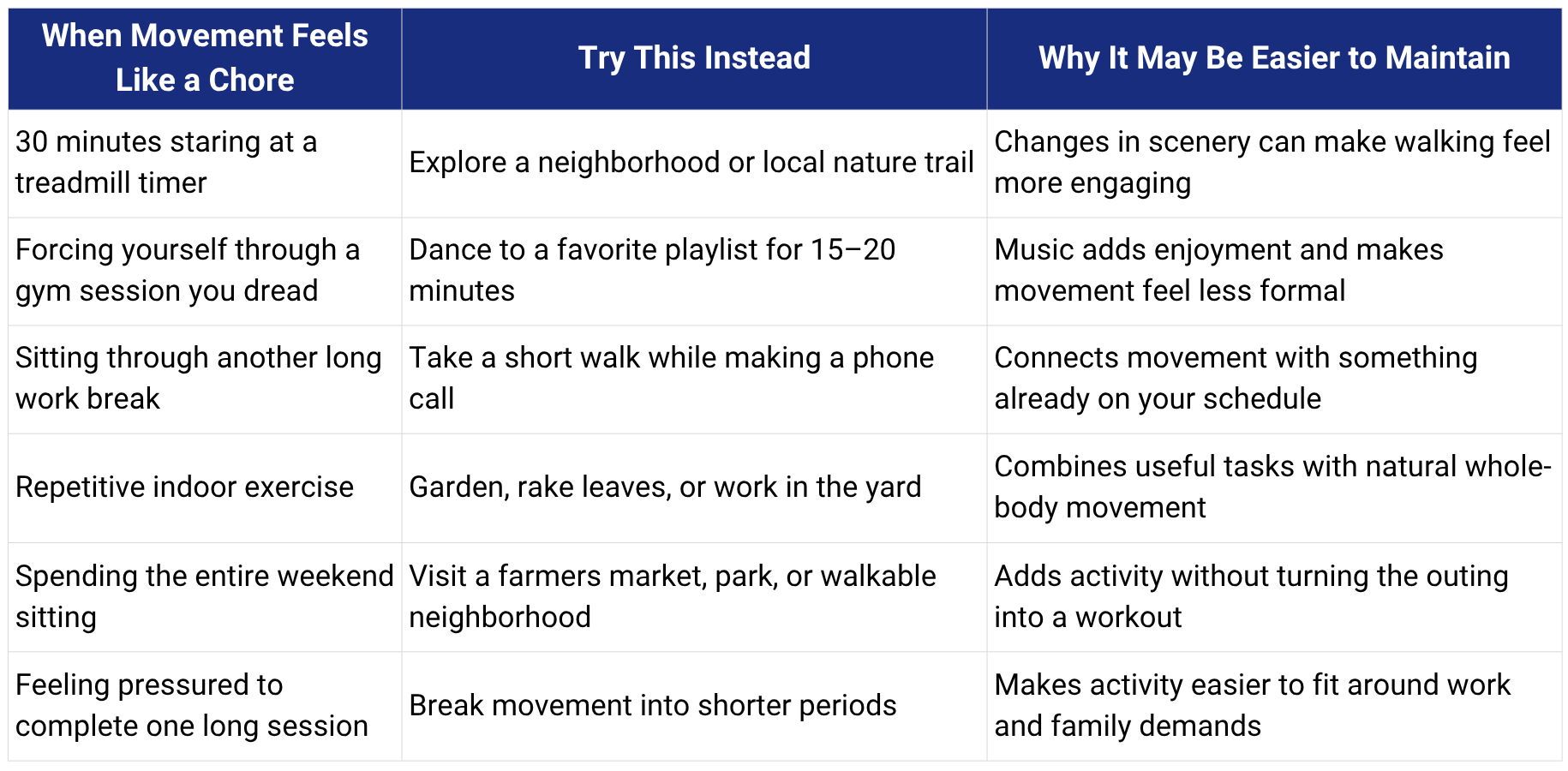
None of these alternatives has to be viewed as a direct substitute for a specific training program. They simply illustrate how movement can become more approachable when it connects with activities you already enjoy or need to do.
Give Your Body the Foundations It Needs for an Active Day
Enjoyable movement becomes easier to sustain when the rest of your wellness routine supports it. Hydration, adequate nutrition, appropriate sleep, rest days, and gradually increasing activity all deserve attention before looking for a supplement to carry the entire responsibility.
Eating enough to support your activity level matters, particularly if you are adding longer walks, recreational sports, or other new movement. A balanced eating pattern provides carbohydrates, fats, protein, vitamins, minerals, and fluids that the body uses across countless normal functions.
Recovery is equally important. Feeling physically challenged after an unfamiliar activity can be normal, but repeatedly pushing through significant pain, dizziness, unusual shortness of breath, or extreme fatigue is not a requirement for making progress. Your activity should generally increase at a pace that allows your body to adapt.
Nutritional ingredients are sometimes studied for their relationship with physical performance as well. Beetroot has received research attention because it can naturally contain dietary nitrate. In one study, Bailey and colleagues examined dietary nitrate supplementation using beetroot juice and reported a reduced oxygen cost during certain exercise conditions and improved exercise tolerance in the small group of healthy men studied.
That research is interesting, but it is important to keep it in context. The study evaluated a specific beetroot juice protocol rather than 1 Body Organic Beet Vital, involved a limited population, and should not be interpreted as evidence that every beetroot product will improve stamina, cardiovascular performance, or exercise capacity. The nitrate content of beetroot ingredients can also vary unless a finished product specifically provides a standardized amount.
This is why supplements are best viewed as additions to an active lifestyle, not shortcuts around movement, nutrition, or appropriate medical care.
Adding 1 Body Organic Beet Vital to an Active Routine
Once you have established the basics of regular movement, hydration, balanced nutrition, and recovery, 1 Body Organic Beet Vital can become a convenient nutritional addition to an active lifestyle. The product is formulated with a concentrated 20:1 beetroot extract, giving people who are interested in beetroot-based supplementation an easy way to include it within a consistent routine.
Rather than expecting a supplement to make movement effortless, think of Organic Beet Vital as something that can sit alongside the habits already supporting your day. Take it according to the current product label, keep your walking, dancing, gardening, or other activity consistent, and pay attention to the overall pattern instead of looking for an immediate or guaranteed result.
Beetroot supplementation may not be appropriate for everyone. People who take medication, manage blood pressure concerns, have kidney or other medical conditions, are pregnant or nursing, or are preparing for a medical procedure should discuss dietary supplements with an appropriate healthcare professional.
Frequently Asked Questions
-
Yes, activities such as walking, dancing, gardening, recreational sports, and active household tasks all involve physical movement even when they do not resemble a traditional workout. The appropriate amount and intensity depend on your health, goals, current fitness level, and professional guidance when needed.
Movement Works Better When It Fits Your Life
Staying active does not have to become another task you spend all day trying to avoid. Movement can happen through a morning walk, an afternoon in the garden, dancing while dinner cooks, playing outside with family, exploring a new trail, or simply standing and moving more often during a workday.
The most sustainable routine is usually not the one that looks most impressive from the outside. It is the one that fits naturally enough into your life that you are willing to return to it even when schedules change, motivation fluctuates, or a new season arrives.
Start by finding movement you enjoy, then support that routine with nutritious food, hydration, sufficient rest, and realistic expectations. Supplements can complement those foundations when they make sense for your individual needs, but the bigger goal remains the same: create an active lifestyle that feels like something you get to participate in rather than another obligation you have to complete.
1 Body Organic Beet Vital
1 Body Organic Beet Vital is a beetroot-based dietary supplement formulated with a concentrated 20:1 beetroot extract and designed to complement an active daily wellness routine. It offers a convenient option for people who want to incorporate beetroot supplementation alongside regular movement, balanced nutrition, hydration, and appropriate recovery without relying on complicated preparation or beetroot juice every day.
-
Features a concentrated 20:1 beetroot extract
-
Provides a convenient way to incorporate beetroot into an everyday wellness routine
-
Designed to complement an active lifestyle and regular physical movement
-
Can fit alongside walking, hiking, dancing, gardening, cycling, and other enjoyable activities
-
Easy to pair with an established morning or pre-activity routine according to label directions
-
Supports a wellness approach built around consistency rather than extreme workouts
-
Offers an alternative for people interested in beetroot supplementation without preparing beetroot juice
-
Intended to complement, not replace, nutritious food, exercise, recovery, or professional healthcare

If you are already working toward a more enjoyable and consistent approach to movement, 1 Body Organic Beet Vital offers a simple way to add beetroot-based nutritional support to the routine you are building. Choose it for convenience and consistency rather than expecting a guaranteed performance outcome, follow the current label carefully, and speak with a healthcare professional when supplementation requires additional guidance.
Reference
Bailey, S. J., Winyard, P., Vanhatalo, A., Blackwell, J. R., DiMenna, F. J., Wilkerson, D. P., Tarr, J., Benjamin, N., & Jones, A. M. (2009). Dietary nitrate supplementation reduces the O₂ cost of low-intensity exercise and enhances tolerance to high-intensity exercise in humans. Journal of Applied Physiology, 107(4), 1144–1155. https://doi.org/10.1152/japplphysiol.00722.2009
For all general inquiries, please contact us at help@1body.com
© Copyright. All rights reserved.