The Best Investment you'll ever Make is in Yourself


A busy season can become draining when commitments leave too little room for sleep, meals, movement, quiet time, and mental recovery. Protecting your schedule with realistic boundaries, intentional downtime, and supportive daily wellness habits can help you stay more present for the things you genuinely want to say yes to.
There are seasons when the calendar seems to fill itself. Work projects overlap, family obligations multiply, invitations arrive faster than you can answer them, and even the activities you normally enjoy start competing for the same small pockets of free time. Saying yes often feels easier in the moment because nobody wants to disappoint a friend, miss an opportunity, or seem unhelpful.
The problem is that every yes has a cost. It requires time, attention, decision-making, preparation, travel, conversation, or simply the mental effort of remembering one more thing. When enough commitments pile up, overcommitment, seasonal stress, mental fatigue, low energy, brain fog, difficulty focusing, and poor work-life balance can begin to feel less like isolated problems and more like the background noise of everyday life.
That does not mean being busy is inherently unhealthy, and it certainly does not mean every demanding week will damage your body. A packed schedule can include rewarding, meaningful experiences. The issue begins when the calendar consistently leaves too little room for the basic things that help you function well: adequate sleep, balanced meals, movement, recovery, quiet, and the freedom to occasionally do nothing.
Learning to protect those basics may be one of the most practical wellness habits you can build.
Why a Full Calendar Can Feel Heavier Than It Looks
Two schedules can look equally busy on paper and feel completely different in real life. Three events you are excited about may be easier to manage than one obligation you have been dreading for days, because the emotional and mental demands of a commitment matter alongside the hours it occupies.
There is also the invisible work surrounding each item on your calendar. A dinner invitation may require coordinating schedules, choosing what to wear, traveling across town, arranging childcare, and getting home later than usual. A work deadline may continue occupying your attention long after you have closed the laptop. Family responsibilities can involve planning and emotional labor that never actually appears as a calendar block.
When those invisible demands accumulate, you may begin feeling as though you are always slightly behind. You finish one obligation only to immediately start thinking about the next, which can make genuine downtime surprisingly difficult even when you technically have an hour free.
This is why time management and stress management are not exactly the same thing. You can organize every minute perfectly and still have too much on the schedule. Sometimes the answer is not a better productivity system; it is fewer commitments.
The Difference Between Being Busy and Being Overextended
Busy can feel energetic and purposeful. Overextended tends to feel as though there is no margin left.
One useful way to tell the difference is to pay attention to what happens when something unexpected occurs. If one delayed appointment, traffic jam, or extra task sends the whole day into chaos, the schedule may already be operating at maximum capacity.
Overcommitment can also make enjoyable activities feel like obligations. You might find yourself checking the time at dinner with friends, thinking about tomorrow's work while attending a family gathering, or feeling strangely relieved when plans are canceled.
That reaction does not mean you no longer enjoy the people in your life. It may simply mean that your capacity and your commitments have stopped matching.
Recovery is another useful clue. A demanding day followed by adequate rest is different from several demanding weeks with no meaningful break between them. When your calendar repeatedly borrows time from sleep, exercise, meals, or quiet evenings, feeling run-down becomes increasingly understandable.
Instead of asking whether you are “busy enough” to justify slowing down, ask whether the current routine is sustainable.
How Overcommitment Can Show Up in Everyday Life
There is no single symptom that proves your schedule is too full, but your normal habits can offer useful feedback.
You may notice yourself depending more heavily on caffeine because sleep has become inconsistent. Meals become whatever is easiest to grab between commitments, exercise disappears because there is never a convenient time, and the idea of completing one more basic household task feels disproportionately irritating.
Mental signs can be equally noticeable. You walk into a room and forget why, reread the same email several times, struggle to make simple decisions, or feel as though your thoughts are constantly switching between unfinished tasks. That does not automatically mean something is medically wrong; attention is a limited resource, and juggling too many competing priorities can make concentration harder.
Mood can shift too. Small inconveniences feel much bigger when there is no space in the day to absorb them, and patience may be shorter after several nights of inadequate sleep or nonstop decision-making.
These signs are best treated as information rather than proof of a particular diagnosis. Fatigue, sleep changes, concentration problems, low mood, and irritability can also occur with medical conditions, medication effects, mental health concerns, or nutritional issues, so persistent or significant symptoms deserve appropriate professional attention.
Why Mental Load Can Drain Your Focus
Every unresolved task takes up a little mental space. You may not be actively working on tomorrow's presentation, remembering a birthday gift, answering a message, planning dinner, and preparing for a weekend event simultaneously, but your mind can continue shifting between those open loops.
This is often described as mental load. It includes not only completing responsibilities but remembering that they need to be completed in the first place.
When that load becomes crowded, focus can feel fragmented. A task that would normally take twenty minutes stretches into forty because notifications, reminders, unfinished decisions, and thoughts about the next obligation repeatedly interrupt your attention.
The first solution is surprisingly low-tech: stop requiring your brain to remember everything. Write commitments down, use one reliable calendar, create realistic task lists, and decide what genuinely does not need to happen this week.
It also helps to reduce unnecessary decisions. Repeating a few simple breakfasts, planning tomorrow's clothes tonight, or setting a regular grocery day may sound small, but reducing dozens of minor choices can create useful mental breathing room.
Focus is not always about forcing yourself to concentrate harder. Sometimes it improves when you give your attention fewer things to compete with.
Boundaries Are a Form of Energy Management
A boundary does not need to sound dramatic. It can be as simple as deciding that Wednesday evenings stay unscheduled, declining a project that does not fit your workload, or leaving an event earlier because tomorrow matters too.
Many people struggle with boundaries because saying no feels personal. Yet declining an invitation is not the same as rejecting the person who extended it.
A warm response can be enough: “Thank you for thinking of me. I can’t make this one, but I really appreciate the invitation.” You do not need to produce an elaborate explanation or prove that your reason is important enough.
Another useful approach is replacing automatic yeses with a pause. Instead of answering immediately, say you need to check your schedule. That short delay gives you enough space to ask whether you actually have the time and energy for the commitment rather than agreeing out of habit.
Boundaries can also protect the activities you do choose. Saying no to one extra obligation may mean arriving at an important family event rested enough to enjoy it instead of simply enduring it.
The goal is not becoming unavailable. It is becoming more intentional about where your availability goes.
Build Recovery Into the Calendar Before You Need It
Rest works much better as a routine than an emergency response.
If every free evening immediately becomes an opportunity to catch up on chores, answer messages, or accept another invitation, your schedule never actually contains recovery time. Eventually, the body may claim it for you through an unproductive weekend spent feeling completely depleted.
Try treating downtime as something legitimate enough to protect.
That might mean leaving one evening unscheduled, taking a quiet lunch away from your screen, finishing work at a consistent time, or keeping part of the weekend intentionally open. Recovery does not have to mean lying still; a walk, easy workout, reading, cooking, music, or time outdoors can all feel restorative depending on the person.
Sleep should remain especially protected. It is tempting to extend the day by staying awake later when there is too much to finish, but repeatedly trading sleep for productivity can make attention, mood, and energy harder to manage the following day.
Food and hydration matter too. A stressful schedule can make balanced meals feel optional, yet running from commitment to commitment on coffee and whatever snack happens to be nearby rarely makes the day feel easier.
Overcommitment vs. Healthy Boundaries at a Glance
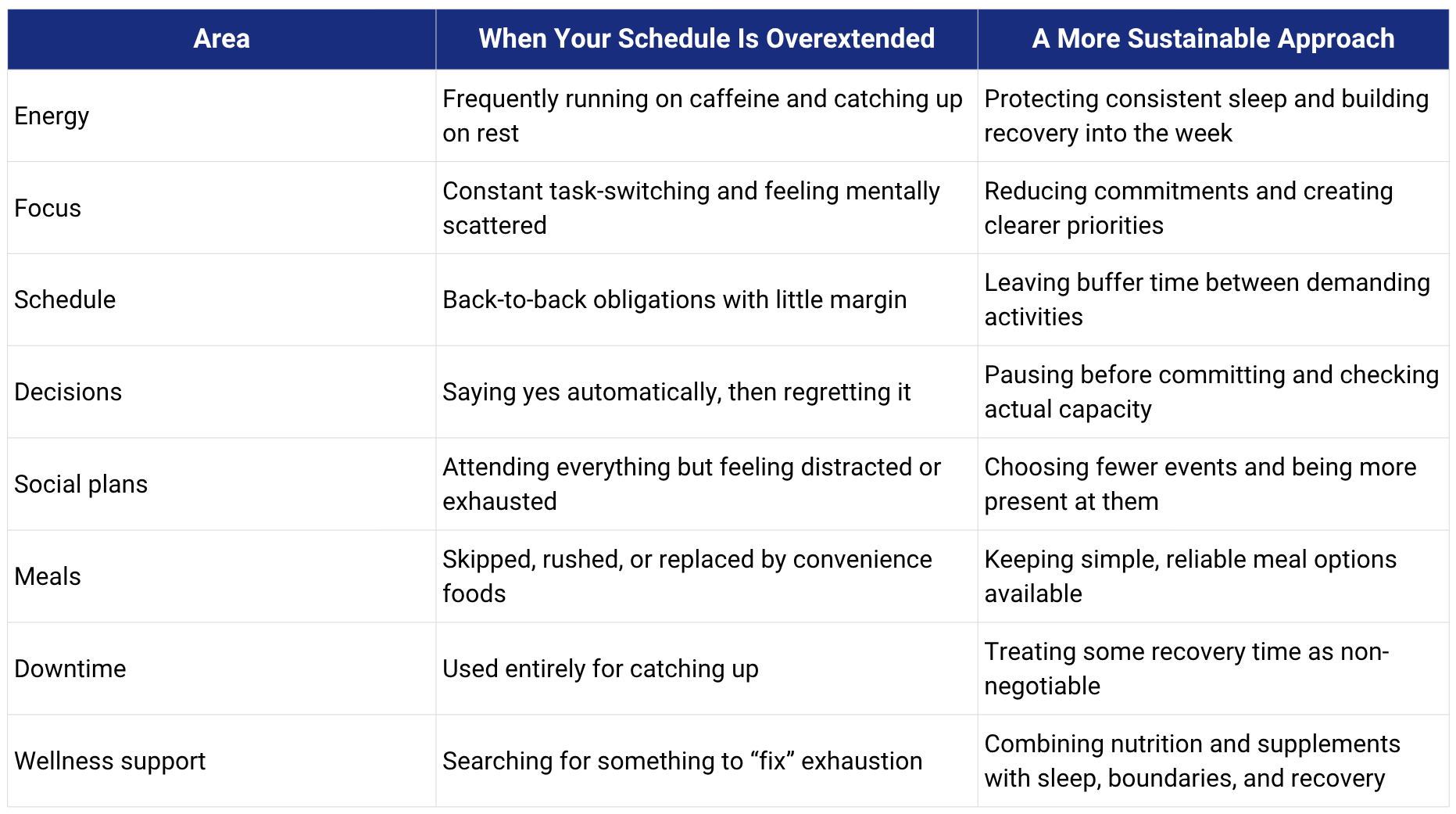
The goal is not a perfectly calm calendar. Real life has demanding weeks. What matters is creating enough flexibility that a temporary rush does not become your permanent operating system.
When Exhaustion Deserves More Than a Schedule Change
Feeling tired during an unusually busy week makes sense. Feeling persistently exhausted regardless of how much you rest deserves a closer look.
Talk with a healthcare professional if fatigue becomes significant or ongoing, particularly when it is accompanied by unexplained weight changes, persistent low mood, shortness of breath, palpitations, fainting, significant sleep disturbance, weakness, or other symptoms that feel unusual for you.
Likewise, “brain fog” is a description rather than a diagnosis. Sleep deprivation, stress, medications, nutritional deficiencies, hormonal conditions, mood disorders, and many other factors can contribute to concentration difficulties.
It is also worth being careful with the popular term “adrenal fatigue.” While ongoing stress can absolutely affect how you feel, “adrenal fatigue” is not an established medical diagnosis, and true adrenal disorders require professional evaluation rather than wellness supplements.
That distinction does not prevent you from supporting everyday stress management nutritionally. It simply keeps wellness support in the right role.
Adding 1 Body Adrenal Support to a More Intentional Routine
After boundaries, sleep, balanced meals, movement, and recovery have a place in your routine, 1 Body Adrenal Support Ashwagandha Complex can be considered as an additional dietary supplement for people who want botanical and nutritional support during demanding periods.
The current 1 Body formula is presented in a 60-capsule, 30-serving format and highlights Shoden® Ashwagandha, L-Tyrosine, Rhodiola, Eleuthero, Schisandra, and B vitamins on its packaging. The product materials position the formula around stress response, calm energy, focus, healthy mood, and mental clarity, although those statements should not be interpreted as promises that the supplement will eliminate fatigue, anxiety, poor concentration, or the effects of an overloaded schedule.
Ashwagandha itself has been studied in people experiencing stress. In one randomized, double-blind, placebo-controlled trial, Chandrasekhar and colleagues reported improvements in perceived stress measures among adults receiving a specific high-concentration ashwagandha root extract over 60 days compared with placebo.
That research is useful context, but it did not test 1 Body Adrenal Support or the exact Shoden®-based multi-ingredient formula shown here. Results from one ashwagandha extract should therefore not be treated as guaranteed outcomes for every product or person.
A supplement works best when it adds to a sustainable routine instead of being asked to compensate for one.
Frequently Asked Questions
-
Social events, travel, conversations, preparation, decision-making, and schedule changes can all require mental and physical energy even when you genuinely enjoy them. Several enjoyable commitments packed together can still leave too little time for sleep and recovery.
You Do Not Have to Fill Every Open Space
One of the quieter lessons of a busy season is that an empty square on the calendar does not automatically need to be filled.
The hour you leave free may become the time you cook a real dinner, take a walk, call someone you genuinely miss, finish work without rushing, or simply sit somewhere without needing to perform another task. That time still has value even when it produces nothing measurable.
Boundaries also make your yeses more meaningful. When you stop agreeing automatically, the commitments that remain are more likely to reflect your actual priorities instead of your fear of disappointing someone.
Nutritional support can fit within that more intentional routine, but it should never carry responsibility that belongs to sleep, recovery, workload, healthcare, or the boundaries you set around your time. Ashwagandha and other supplemental ingredients may be worth considering for some adults, yet no capsule can create downtime that does not exist.
The goal is not to become perfectly calm or endlessly productive. It is to create enough margin that you can move through a demanding season without feeling as though every day requires you to run at maximum capacity.
Sometimes protecting your health begins with one small sentence: “I can’t take that on right now.”
Give Your Busy-Season Routine Thoughtful Support With 1 Body Adrenal Support
1 Body Adrenal Support Ashwagandha Complex offers a convenient dietary supplement for adults who want to incorporate adaptogenic botanicals and supporting nutrients into an established wellness routine. The current formula contains 60 capsules, providing 30 servings, and combines Shoden® Ashwagandha with ingredients including L-Tyrosine, Rhodiola, Eleuthero, Schisandra, and B vitamins.
-
Features Shoden® Ashwagandha
-
Includes L-Tyrosine
-
Contains Rhodiola
-
Includes Eleuthero
-
Features Schisandra
-
Includes B vitamins
-
60 capsules / 30 servings
-
Convenient capsule format for an established daily wellness routine
-
Designed around everyday stress-response, energy, mood, and focus support according to the product materials
-
Best used alongside adequate sleep, balanced nutrition, regular movement, and realistic boundaries
-
Not intended to diagnose or treat adrenal disorders, chronic fatigue, anxiety disorders, or other medical conditions

If the busiest parts of your year tend to leave your routine feeling scattered, 1 Body Adrenal Support can provide a simple supplemental step alongside the habits that matter most. Use it according to the current label, review medications and health conditions with a qualified healthcare professional when appropriate, and choose it as support for a balanced routine—not as permission to keep saying yes after your calendar is already full.
Reference
Chandrasekhar, K., Kapoor, J., & Anishetty, S. (2012). A prospective, randomized double-blind, placebo-controlled study of safety and efficacy of a high-concentration full-spectrum extract of ashwagandha root in reducing stress and anxiety in adults. Indian Journal of Psychological Medicine, 34(3), 255–262. https://doi.org/10.4103/0253-7176.106022
For all general inquiries, please contact us at help@1body.com
© Copyright. All rights reserved.