The Best Investment you'll ever Make is in Yourself


The fall equinox marks the seasonal transition toward shorter days and longer nights, and that changing light pattern can influence sleep timing, morning alertness, activity, and daily energy. Morning sunlight, regular sleep, balanced meals, movement, and appropriate nutritional support can help create a steadier routine as your body adjusts to autumn.
There is something noticeable about the first few weeks of fall. The evenings arrive earlier, mornings feel darker, and the amount of usable daylight seems to shrink almost overnight. Even if your work schedule has not changed, you may find yourself wanting to stay in bed longer, losing steam earlier in the afternoon, or feeling ready to wind down sooner than you did in midsummer.
That shift is not necessarily a sign that something is wrong. The fall equinox is simply the point in the year when day and night are approximately equal in length, after which daylight continues decreasing in many parts of the Northern Hemisphere. Your body pays attention to those changes because light is one of the strongest environmental signals involved in regulating your circadian rhythm, the internal timing system that helps organize sleep, wakefulness, appetite, and daily patterns of alertness.
Fall energy support is therefore less about fighting the season and more about adapting to it. Small changes in light exposure, sleep timing, movement, food choices, and morning routines can make autumn feel far more manageable without turning the season into another wellness project.
Why the Fall Equinox Can Feel Like an Energy Turning Point
The equinox itself does not suddenly flip a switch inside the body. What matters more is the broader pattern surrounding it: later sunrises, earlier sunsets, cooler temperatures, changes in activity, and a return to busier school or work schedules.
In summer, it is common to receive natural light early in the morning and well into the evening. You may also spend more time outside, walk more, socialize later, and stay naturally active because the days feel longer. When fall arrives, many of those cues begin changing together.
For some people, the result is a temporary sense that energy is less predictable. Morning alertness may come more slowly, while the late afternoon can feel heavier than it did only a few weeks earlier. Evening sleepiness may also appear earlier because darkness arrives sooner.
Research into natural light exposure supports the importance of seasonal light patterns. In a Current Biology study, researchers found that exposure to natural summer and winter light-dark cycles was associated with measurable changes in circadian timing. The findings do not mean that seasonal tiredness can be cured with sunlight, but they do suggest that the body’s internal timing system responds meaningfully to changes in environmental light.
The practical takeaway is simple: if your schedule feels out of sync in early fall, paying attention to when you get light, when you sleep, and how your day is structured may be more useful than assuming you simply need more caffeine.
Shorter Days Can Shift Your Internal Clock
Melatonin is commonly called the sleep hormone because the body generally begins releasing more of it as evening darkness increases. Light exposure can influence the timing of this process, which is one reason early sunsets may make some people feel ready for rest sooner than expected.
This does not mean that autumn automatically causes unusually high melatonin levels or that everyone will become sleepy at the same time. Circadian timing varies from person to person, and work schedules, screen habits, artificial lighting, travel, stress, and sleep history all influence the experience.
Morning light is particularly useful because it provides a clear signal that the daytime portion of your rhythm has begun. When possible, open your blinds shortly after waking, spend a little time outdoors, or pair breakfast with natural light. Even on cloudy mornings, outdoor light is generally brighter than typical indoor lighting.
Evening habits can support the other end of the rhythm. If your entire home remains brightly lit until bedtime while you move between work email, television, and your phone, the transition into rest may feel more abrupt. Lowering the lights and reducing stimulating tasks during the final part of the evening can make the day feel more clearly divided between activity and downtime.
Think of seasonal sleep support as creating stronger cues rather than forcing your body to perform on command.
Why Afternoon Energy May Feel Less Predictable
An afternoon energy dip during fall is not necessarily caused by one hormone or one nutrient. Several ordinary factors often overlap.
First, shorter days may reduce outdoor activity. If you normally take an evening walk in summer but stop once it becomes dark earlier, your daily movement can drop without you realizing it. More time indoors may also mean longer stretches of sitting, especially during workdays.
Second, eating patterns can change. Busier autumn schedules may lead to skipped breakfasts, rushed lunches, or heavier comfort foods that are delicious but not always balanced with enough protein, fiber, or vegetables. That can leave the afternoon feeling inconsistent.
Caffeine may enter the picture too. It is tempting to reach for another coffee when the sky becomes dark at 4 or 5 p.m., but late-day caffeine can interfere with sleep for some people. The next morning then feels harder, which creates a cycle of needing more caffeine to compensate.
Hydration is another easy habit to lose as the weather cools. People may feel less thirsty than they did in summer, even though their daily fluid needs have not disappeared.
The point is not to blame autumn for every tired day. It is to recognize that the season often changes several routines at once, and those small changes can add up.
Food, Movement, and Morning Light Matter More Than You Think
The strongest seasonal wellness routine is usually built around simple foundations rather than complicated fixes.
A balanced breakfast can make mornings feel more anchored. Eggs and whole-grain toast, oatmeal with nuts and fruit, yogurt with seeds and berries, or another combination of protein and fiber-rich carbohydrates can provide a more complete start than relying entirely on coffee.
Movement can be equally straightforward. If your usual evening walk no longer works because it is dark, move it to lunchtime or immediately after work. A short indoor strength routine, stretching session, or brisk walk can help keep the habit alive when weather becomes less predictable.
Regular meals matter more than seasonal “superfoods.” Root vegetables, oats, beans, leafy greens, nuts, seeds, eggs, fish, poultry, whole grains, and fruit can all fit naturally into fall eating patterns. Warm soups, stews, grain bowls, and roasted vegetables are especially convenient because they can be prepared in batches.
The following table offers a simple way to translate common fall changes into supportive habits:
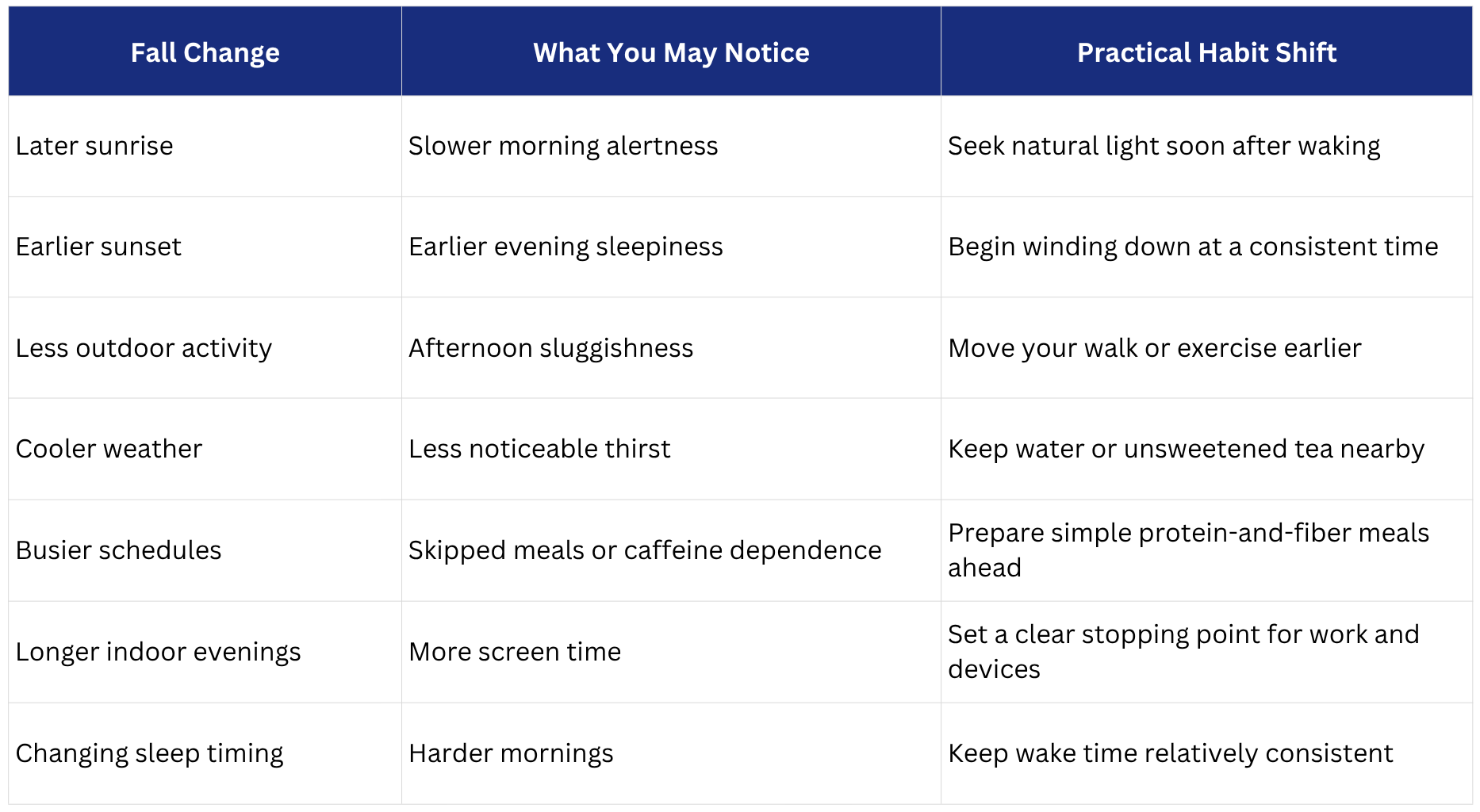
None of these habits guarantees more energy, but together they create a routine that is better matched to the season.
Build a Fall Routine That Works With Your Body
A common mistake is trying to maintain exactly the same pace in every season. Summer may naturally support later dinners, longer walks, and more evening activities, while fall may feel better with earlier meals and a more predictable bedtime.
Instead of resisting that shift, consider what can be adjusted without disrupting your responsibilities.
Start with the morning. Set a consistent wake time, get daylight when possible, drink water, and eat something nourishing. Those four actions can establish a stronger rhythm before the day becomes busy.
During the afternoon, use movement rather than caffeine as your first response to sluggishness when practical. A ten-minute walk, a few flights of stairs, or even stretching away from your desk can create a useful reset.
In the evening, create one boundary between work and rest. That might mean closing your laptop at a set time, putting your phone on a charger outside the bedroom, or dimming the lights an hour before bed.
Sleep consistency matters more than trying to create the perfect routine. If you can keep bedtime and wake time within a reasonable range, your body has a clearer daily pattern to follow.
Seasonal tiredness should still be kept in perspective. Persistent fatigue can also be related to anemia, thyroid concerns, sleep disorders, medication effects, nutrient deficiencies, mood changes, infection, and many other health factors. If your energy does not improve with reasonable sleep and lifestyle adjustments, professional evaluation is more appropriate than assuming the equinox is responsible.
When Nutritional Support May Fit Into Your Seasonal Routine
Once light exposure, sleep, meals, hydration, and movement are in place, some adults consider a dietary supplement to complement their seasonal wellness routine.
1 Body Methylated Vitamin B Complex provides a broad range of B vitamins, including a methylated form of folate known as 5-MTHF, along with nutrients such as vitamin B12, vitamin B6, riboflavin, thiamin, niacin, and biotin. B vitamins participate in normal processes involved in energy metabolism and nervous system function, which makes a B-complex a natural fit for adults looking to support everyday nutritional needs during a changing seasonal routine.†
The important distinction is that B vitamins do not work like a stimulant and should not be described as providing an instant energy boost. If someone is already obtaining adequate amounts, taking more does not guarantee feeling more energetic. A supplement is best positioned as nutritional support rather than a solution for persistent fatigue.
1 Body Methylated Vitamin B Complex can fit easily into a dependable morning or mealtime habit, making consistency simpler. Adults who take medication, are pregnant or breastfeeding, have a medical condition, or are experiencing unexplained fatigue should speak with a qualified healthcare professional before adding a new supplement.
Frequently Asked Questions
-
Shorter daylight, changing sleep timing, reduced activity, busier schedules, and shifts in eating or caffeine habits may all contribute to feeling more tired in early fall. Persistent or significant fatigue deserves professional evaluation rather than being automatically attributed to the season.
Let Autumn Become a Reset, Not a Slowdown
The fall equinox does not have to mark the beginning of months spent fighting low energy. It can instead become a useful reminder that your environment has changed and your daily routine may need to change with it.
Start with the signals your body receives every day. Get natural light in the morning, maintain a reasonably consistent sleep schedule, move while daylight is available, eat balanced meals, drink enough fluids, and reconsider late-afternoon caffeine when it begins interfering with the night ahead.
Most importantly, avoid interpreting every dip in energy as something you need to push through. Sometimes a seasonal adjustment calls for a slightly earlier night or a slower evening. At other times, persistent fatigue is a signal worth discussing with a healthcare professional.
Nutritional support can complement these foundations, but the best fall routine is still built around the habits that help your body understand when it is time to be active and when it is time to recover.
Support Your Fall Routine With 1 Body Methylated Vitamin B Complex
1 Body Methylated Vitamin B Complex is formulated with essential B vitamins, including 5-MTHF methylated folate, vitamin B12, vitamin B6, thiamin, riboflavin, niacin, and biotin. The formula is designed to complement balanced nutrition and support normal energy metabolism, brain and nerve health, and everyday nutritional wellness as part of a consistent routine.†
Formula and wellness-supporting features include:
-
Features 5-MTHF methylated folate
-
Includes vitamin B12
-
Includes vitamin B6
-
Provides thiamin (vitamin B1)
-
Provides riboflavin (vitamin B2)
-
Includes niacin (vitamin B3)
-
Includes biotin
-
Supports normal energy metabolism†
-
Supports normal nervous system function†
-
Complements a balanced fall nutrition routine
-
Easy to pair with an established morning or mealtime habit
-
Designed as dietary support rather than a stimulant or treatment for fatigue

For adults who want to keep their nutritional routine consistent as daylight and schedules change, 1 Body Methylated Vitamin B Complex offers a straightforward way to include a broad range of B vitamins in one daily formula. It fits naturally alongside morning light, balanced meals, regular movement, and restorative sleep, reflecting 1 Body’s warm, accessible approach to combining nature-inspired wellness with thoughtful formulation.
†These statements have not been evaluated by the Food and Drug Administration. This product is not intended to diagnose, treat, cure, or prevent any disease.
Reference
Stothart, G., McHill, A. W., Depner, C. M., Birks, B. R., Moehlman, T. M., Ritchie, H. K., Guzzetti, J. R., Chinoy, E. D., LeBourgeois, M. K., Axelsson, J., & Wright, K. P., Jr. (2017). Circadian entrainment to the natural light-dark cycle across seasons and the weekend. Current Biology, 27(4), 508–513. https://doi.org/10.1016/j.cub.2016.12.041
For all general inquiries, please contact us at help@1body.com
© Copyright. All rights reserved.