The Best Investment you'll ever Make is in Yourself

Box breathing is a simple technique that may help support your body’s stress response in the moment, and when paired with consistent habits, it can contribute to a more balanced and calm daily rhythm.
Why Your Body Stays in “Fight or Flight”
Stress is not always obvious. While some stressors are clear and immediate, many people spend large parts of their day in a low-level state of tension without fully realizing it. This is often referred to as the “fight or flight” response, where the body remains alert, reactive, and ready to respond.
As conversations around stress support, cortisol balance, and relaxation techniques continue to grow, it has become clear that the modern lifestyle plays a significant role in how often this response is activated. Notifications, deadlines, and constant stimulation can keep the nervous system engaged long after the initial stressor has passed.
Cortisol, often referred to as the body’s primary stress hormone, plays a role in this process. It helps regulate energy, alertness, and the body’s response to stress. However, when stress becomes more frequent or prolonged, it can influence how balanced that response feels throughout the day.
Research has explored how controlled breathing practices may influence the autonomic nervous system and support a more relaxed state. For example, a study published in the Indian Journal of Psychological Medicine discusses how slow, structured breathing patterns may help shift the body toward a calmer physiological response. While this does not suggest a direct solution, it highlights how simple practices can play a role in supporting how the body responds to stress.
This is where techniques like box breathing come into the conversation, not as a quick fix, but as a tool that helps you reconnect with your body’s natural rhythm.
What is Box Breathing and How It Works
Box breathing is a structured breathing technique that follows a simple, repeatable pattern. It has been used in high-performance environments, from athletes to military training, because of its simplicity and accessibility.
The technique follows four equal steps:
-
Inhale for 4 seconds
-
Hold for 4 second
-
Exhale for 4 seconds
-
Hold again for 4 seconds
This creates a “box” pattern, which is where the name comes from. The goal is not to breathe deeply or forcefully, but to create a steady, controlled rhythm.
From a physiological perspective, slow and controlled breathing is often associated with activating the parasympathetic nervous system, sometimes referred to as the “rest and digest” state. This is the counterpart to the “fight or flight” response.
By focusing on your breath, you also shift your attention away from external stressors. This combination of physical rhythm and mental focus can create a sense of calm that feels more grounded and immediate.
However, while box breathing can be helpful in the moment, many people find that long-term stress support requires a more consistent, daily approach.
Supporting Your Stress Response Over Time
Managing stress is not just about what you do in a single moment. It is about how your body responds throughout the day and over time. This is where daily habits begin to matter.
Sleep quality, nutrition, hydration, and movement all play a role in how your body handles stress. When these elements are inconsistent, it can make it more difficult to maintain a sense of balance.
This is also where the concept of adaptogens often comes into the conversation. Adaptogens are compounds that have been studied for their relationship with how the body responds to stress. Ingredients like Ashwagandha and Rhodiola are commonly discussed in this context.
For example, Ashwagandha has been explored in research related to stress and cortisol levels. A study published in the Journal of the American Nutraceutical Association examined its role in stress response, noting areas of interest in how it may interact with the body’s natural processes. While findings vary and should not be interpreted as definitive outcomes, they contribute to the broader understanding of how certain ingredients are being studied.
Similarly, Phosphatidylserine has been researched for its connection to cognitive function and stress-related pathways, particularly in relation to how the body responds during mentally demanding situations.
These ingredients are not solutions on their own, but they are often part of a more comprehensive approach to supporting relaxation, focus, and overall well-being.
Supporting Your Stress Routine, Moment by Moment
Supporting your stress response often involves a combination of in-the-moment techniques and consistent daily habits. Each plays a different role, and together they can help create a more balanced routine.
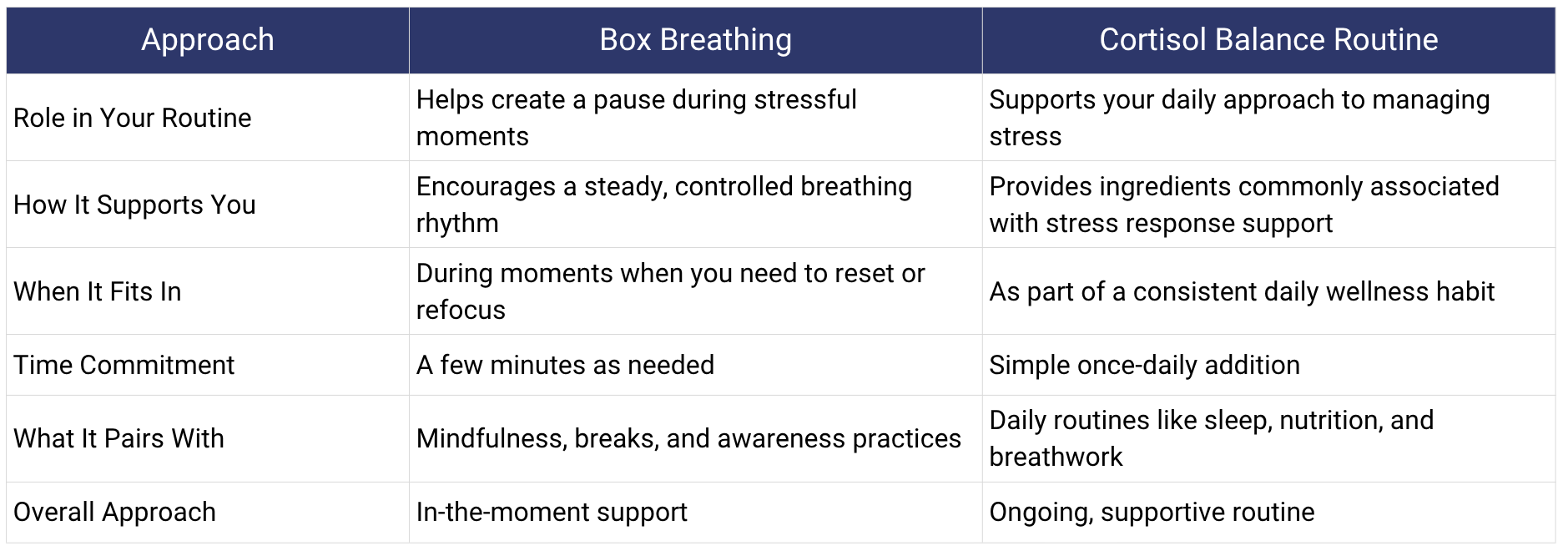
A More Consistent Approach to Calm
As you begin to combine techniques like box breathing with consistent daily habits, a pattern starts to emerge. Calm becomes less about reacting to stress and more about building a foundation that supports your body throughout the day.
This is where routine plays an important role. When your body knows what to expect, it becomes easier to maintain balance. Simple actions, repeated consistently, can create a sense of stability that carries through even during more demanding moments.
Many people find that pairing breathwork with supportive daily practices helps reinforce this consistency. Whether it is setting aside time to pause during the day or creating a structured evening routine, these habits can help create a more grounded rhythm.
For those looking to take this a step further, some choose to incorporate targeted nutritional support as part of their daily routine.
A formula like 1 Body Cortisol Balance, which includes ingredients such as Shoden® Ashwagandha, Rhodiola, and Phosphatidylserine, is often used by individuals looking to support their body’s response to stress as part of a broader wellness approach.
Rather than replacing habits like breathwork, it fits into the routine as a consistent element, supporting the same goal of creating a more balanced and calm daily experience.
Frequently Asked Questions
-
Box breathing is a structured breathing technique that follows a simple pattern of inhaling, holding, exhaling, and holding again for equal counts. It is often used as a way to bring awareness to your breath and support a more controlled, steady breathing rhythm.
Building a More Balanced Response to Stress
Managing stress is not about eliminating it entirely. It is about supporting how your body responds to it. When you begin to understand the role of your nervous system, your breath, and your daily habits, you gain more control over how you move through your day.
Box breathing offers a simple starting point. It gives you a tool that is always available, allowing you to pause and reset in the moment. Over time, pairing that with consistent habits can create a more stable foundation for calm.
Rather than relying on quick fixes, this approach focuses on building a system that supports your body over time. Small, intentional changes can add up, helping you feel more balanced, focused, and grounded in your daily life.
Product Feature: Support Your Daily Calm
As you build a more consistent approach to managing stress, having supportive elements in place can help reinforce that routine.
1 Body Cortisol Balance is designed to complement your daily habits with ingredients commonly associated with stress support:
-
Shoden® Ashwagandha A high-potency extract studied for its relationship with stress response
-
Rhodiola Rosea Often researched for its role in supporting energy and resilience
-
Phosphatidylserine Associated with cognitive function and stress-related pathways
-
Supports Relaxation and Focus Designed for those looking to maintain balance throughout the day
-
Simple Daily Addition Fits easily into your routine alongside breathwork and lifestyle habits
When combined with consistent practices like box breathing, it becomes part of a more complete approach to supporting calm, focus, and overall well-being.
Citation: Jerath, R., Edry, J. W., Barnes, V. A., & Jerath, V. (2015). Physiology of long pranayamic breathing: Neural respiratory elements may provide a mechanism that explains how slow deep breathing shifts the autonomic nervous system. Indian Journal of Psychological Medicine, 37(4), 373–377. https://doi.org/10.4103/0253-7176.168559
Chandrasekhar, K., Kapoor, J., & Anishetty, S. (2012). A prospective, randomized double-blind, placebo-controlled study of safety and efficacy of a high-concentration full-spectrum extract of Ashwagandha root in reducing stress and anxiety in adults. Journal of the American Nutraceutical Association, 14(1), 14–22. https://pubmed.ncbi.nlm.nih.gov/23439798/
For all general inquiries, please contact us at help@1body.com
© Copyright. All rights reserved.